

Achilles pain — it starts below the tendon

The Achilles is the strongest tendon in the body — but excessive pronation often forces it to work asymmetrically, creating a "wringing" effect that can accelerate degeneration. Interpod addresses this at the source.

🎓 8 independent university studies

🔬 Rearfoot Wedge inverts the calcaneus — reducing Achilles torsion

Does this sound like you?

Recognise any of these symptoms?

  • Pain at the back of the heel or lower calf, especially in the morning

  • Stiffness in the Achilles that eases with gentle movement

  • Pain that worsens with running, jumping, or hill walking

  • Thickening or swelling of the tendon

  • Pain that improves during exercise but returns afterward

  • Tenderness when squeezing the tendon between your fingers
Achilles tendinopathy can be a degenerative condition, not simply inflammation. The tendon's structure can break down from repeated overload. Treatment must address both loading and biomechanical forces.

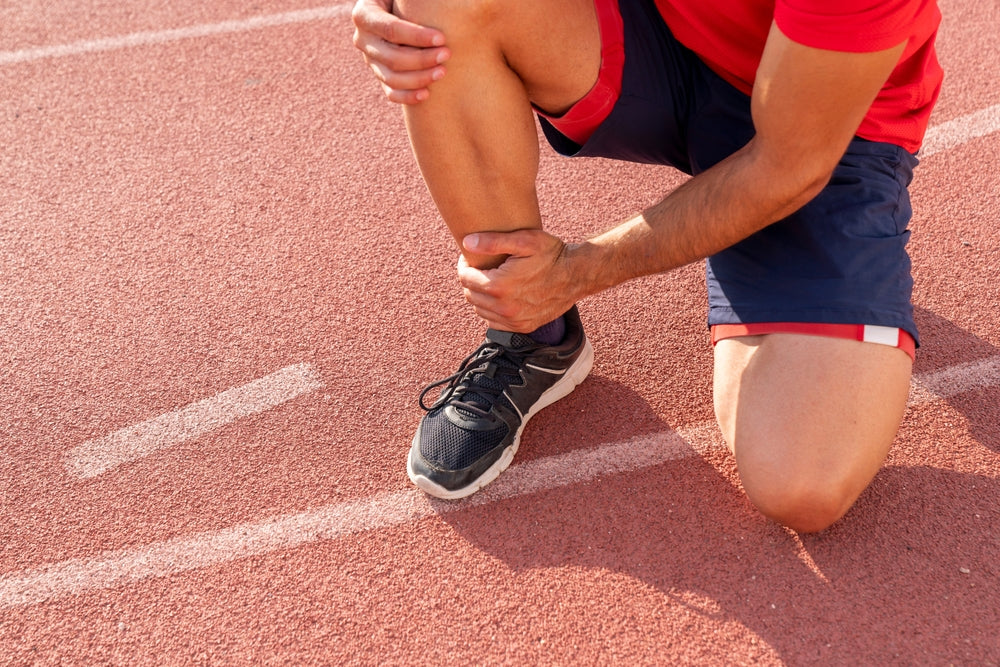
A close-up of a runner kneeling on a red running track, holding and examining their shin while wearing a red and navy athletic outfit and a black running shoe.

Understanding Your Pain

Why pronation damages the Achilles

The Achilles connects the calf muscles to the calcaneus and transmits up to 8x body weight during sprinting. When the foot pronates, the calcaneus everts — but the calf pull remains vertical. This creates a torsional "wringing" effect: the bottom of the tendon rotates while the top doesn't.

Repeated asymmetric loading oten causes micro-damage, collagen disarray, and tendon degeneration. This is why calf stretching and eccentric exercises alone aren't always enough — if the pronation forces creating asymmetric loading aren't addressed, the tendon continues to be overloaded.

Achilles tendinopathy presents in two locations: mid-portion (2–6cm above the heel) and insertional (where the tendon attaches to the calcaneus). Both are driven by excessive loading compounded by pronation-induced torsion.

The Rearfoot Wedge and Achilles protection

By inverting the calcaneus, the Rearfoot Wedge realigns the tendon's attachment — reducing torsional stress and restoring more symmetrical loading.

Your Treatment Plan

Your path to healing — step by step

Jump in at the stage that matches where you are right now.

1

Right now — Reduce the load

Protect the tendon

  • Reduce high-impact activity - decrease running volume. Avoid hills and speed work temporarily.

  • Temporary heel lift - 6–10mm in both shoes reduces Achilles stretch. Short-term measure while the tendon settles.

  • Ice after activity - 15 minutes on the tendon after weight-bearing exercise.

  • Isometric calf holds - single-leg calf raise held for 45 seconds, 5 times. Provides immediate pain relief.

  • Avoid aggressive stretching - gentle stretching only. Overstretching further irritates an acute Achilles.

2

Weeks 1–4 — Strengthen the tendon

Progressive loading rehabilitation

Achilles tendinopathy responds best to progressive loading — eccentric exercises stimulate tendon remodelling and are the gold standard of treatment.
  • Eccentric heel drops (Alfredson protocol) - stand on a step, rise on both feet, lower slowly on affected leg. 3 sets of 15, twice daily. Some discomfort is acceptable.

  • Heavy slow resistance - alternative to eccentrics: slow calf raises (3 seconds up, 3 seconds down), progressively weighted.

  • Cross-train - cycling, swimming, pool running maintain fitness without overloading the tendon.

3

Weeks 4–12 — Professional rehabilitation

Comprehensive treatment

  • Physiotherapy - supervised loading programme, manual therapy, graded return-to-sport plan.

  • Gait assessment - assess pronation pattern and determine if biomechanical correction is needed alongside loading.

  • Progressive return to running - walk-run programme with careful monitoring of morning stiffness as a guide.

4

The long-term solution — Address the torsion

Biomechanical correction with the Model P

Eccentric exercises strengthen the tendon. But if pronation forces creating torsional loading haven't changed, the tendon continues to be loaded asymmetrically — increasing recurrence risk.
  • Rearfoot Wedge - inverts the calcaneus, realigning the tendon attachment and reducing the torsional wringing effect.

  • Cuboid Notch - assists supination, reducing the duration of pronation and Achilles torsion during stance.

  • 1st Cutaway + Plantar Fascial Groove - improve push-off efficiency, reducing compensatory Achilles loading.

Eccentric exercises build a stronger tendon. Orthotics ensure it's loaded symmetrically.Together, they address both the capacity of the tendon and the forces acting on it.

5

Ongoing — Prevent recurrence

Protect for life

  • Wear orthotics daily - consistent use protects the tendon long-term.

  • Maintain calf strength - heel raises 2–3 times per week preventively.

  • Follow the 10% rule - never spike training volume.

  • Monitor morning stiffness - stiffness lasting more than 10 minutes is an early warning. Back off if this returns.

Why Interpod Works

Four design features that resist pronation and assist supination

Generic insoles only have arch support. Interpod has four biomechanical design features — the same features found in custom orthotics costing $500+.

  • Plantar Fascial Groove ★

    A groove engineered into the orthotic to accommodate the plantar fascia. Reduces the force needed to establish the windlass mechanism — the foot's natural arch-raising system. Directly reduces the strain that causes plantar fasciitis.

    Assits supination
  • Rearfoot Wedge ★

    Resists the excessive pronation forces that over-flatten the arch and overload the plantar fascia. By inverting the calcaneus, it reduces the strain transmitted to the fascia during loading.

    Resists pronation
  • 1st Cutaway

    Allows the first metatarsal to plantarflex naturally during push-off, enabling the windlass mechanism to function properly without interference from the orthotic.

    Assits supination
  • Cuboid Notch

    Assists supination during the transition from midstance to push-off, stabilising the lateral column. Typically only found in custom-made orthotics.

    Resists pronation

Common Questions

Achilles Tendinopathy FAQs

Is it tendinitis or tendinopathy?

Most chronic Achilles conditions involve degeneration (tendinopathy) rather than acute inflammation (tendinitis). The collagen structure breaks down from repeated overload. Anti-inflammatory medication alone rarely resolves it — the tendon needs progressive loading combined with biomechanical correction.

Do orthotics help Achilles tendinopathy?

Yes — when associated with excessive pronation. The Rearfoot Wedge reduces torsional loading on the tendon by inverting the calcaneus. Most effective when combined with eccentric loading — addressing both the tendon's capacity and the forces acting on it.

Heel lift or orthotic?

A heel lift is useful short-term to reduce Achilles stretch. But it doesn't address pronation. An orthotic with a rearfoot wedge addresses the underlying cause. Some practitioners recommend both initially, transitioning to orthotics alone as the tendon improves.

What if the orthotics don't help?

You're covered by our 90-day full refund guarantee. Persistent tendinopathy may require shockwave therapy or PRP injections. Consult a sports medicine practitioner. Contact us at help@interpod-orthotics.com.

Related Conditions

Interpod also treats

Start your path to lasting relief today

Australians have discovered that the right support can make everyday movement easier. Find the Interpod orthotic that suits your needs.

Try risk-free — 90-day full refund guarantee.