

Runner's knee — quiet the ache around your kneecap

Patellofemoral pain is the single most common running injury. We'll guide you from settling the symptoms to the strengthening and biomechanical support that address why it started — backed by university research and 25 years of podiatry science.

🎓 8 independent university studies

🏃 The most common running injury

🔬 Interpod reduces internal tibial rotation — a driver of patellar tracking stress

Does this sound like you?

Recognise any of these symptoms?

  • A dull ache around or behind the kneecap

  • Worse going down stairs or hills

  • Worse with squatting, kneeling, or deep bends

  • Aches after sitting a long time with the knee bent — the "theatre sign"

  • A grinding or clicking sensation in the knee

  • Pain that builds during or after running
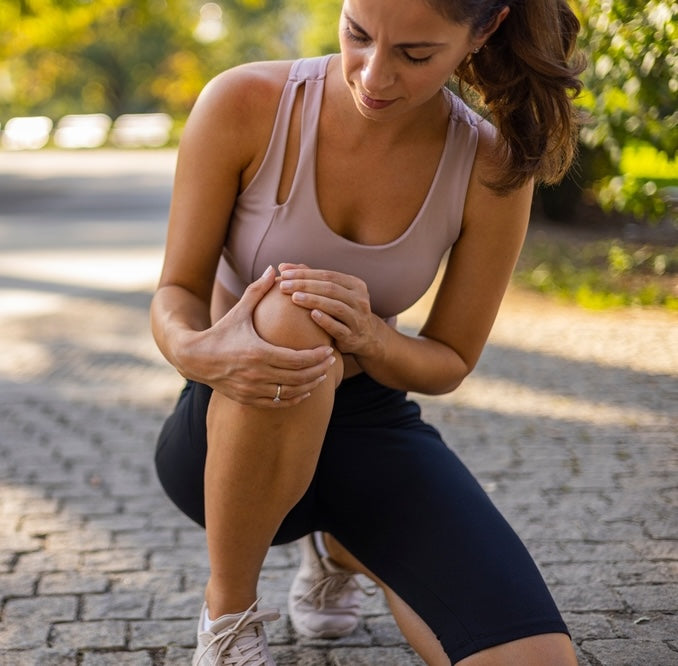
If you recognise two or more of these, it may be patellofemoral pain — runner's knee. It's highly treatable with the right plan, and you're in the right place.

Woman in athletic wear holding her knee outdoors on a paved path.

Understanding Your Pain

What's really causing that ache behind the kneecap?

Your kneecap (patella) glides in a shallow groove at the end of the thigh bone every time you bend and straighten the knee. Runner's knee — patellofemoral pain — is what happens when the joint between them is loaded more than the tissue can comfortably tolerate.

It isn't usually a single injury. It builds up: repeated loading from running, stairs, and squatting, combined with the way the kneecap is being guided through its groove. When the line of pull is even slightly off, stress concentrates on one part of the joint — and that's felt as the familiar ache around or behind the kneecap.

What pulls the kneecap off line. Two things upstream matter most: the quadriceps, which guide the kneecap directly, and the hip muscles, which control how the whole leg is positioned. When the hip stabilisers tire, the thigh rolls inward, the knee drifts into a knock-kneed position, and the kneecap is dragged off its ideal path.

Where your feet come in. When the foot pronates excessively, the shin bone rotates inward — and that rotation changes the angle at which the kneecap sits in its groove. It's why the research shows that the runners who pronate more tend to respond best to foot support. Resisting that pronation takes one source of stress off the joint.

The "wearing out" myth

Many people assume an aching kneecap means the cartilage is wearing out or arthritis is setting in. In active people, runner's knee is almost always a load-and-tracking problem, not joint damage — which is why it responds so well to changing the load and the mechanics. It's also why strengthening the knee alone often isn't enough: the drivers usually sit at the hip and the foot.

Your Treatment Plan

Your path to healing — step by step

Jump in at the stage that matches where you are right now.

1

Right now — Settle the symptoms

Calm the joint down

Your first priority is to reduce the activities loading the joint so the irritation can settle. This buys you the window to address the cause.
  • Ease off the aggravating activities — running, stairs, deep squats, and prolonged kneeling — for a short period.

  • Ice the front of the knee — 15–20 minutes after activity.

  • Anti-inflammatory medication — short-term NSAIDs. Ask your pharmacist for advice.

  • Relative rest, not total rest — keep moving in pain-free ranges; complete inactivity tends to weaken the very muscles you need.

  • Don't push through sharp pain — especially descending stairs and hills.

2

This week — Reduce the load

Take the pressure off the kneecap

While symptoms settle, reduce the load going through the joint and set up the right conditions for it to recover.
  • Cut back on hills and stairs where you can — descending loads the patellofemoral joint most.

  • Reduce running volume temporarily — and avoid deep squatting and lunging for now.

  • Wear supportive, structured footwear — and avoid flat, unsupportive shoes.

  • Stay active in low-load ways — swimming, cycling (seat high, light resistance), or pool running maintain fitness.

3

Weeks 2–6 — Strengthen and retrain

Build the strength that guides the kneecap

This is the most important step. Runner's knee responds best to building the strength that controls how the kneecap tracks — at both the knee and the hip.
  • Strengthen the quadriceps — pain-free range squats, leg press, and step-downs build the muscle that guides the kneecap directly.

  • Strengthen the hips — glute and hip-abductor work controls the inward roll of the thigh that pulls the knee out of line. The research increasingly points to the hip as the key.

  • See a physiotherapist — manual therapy, patellar taping, and a tailored loading programme can speed recovery, especially early on.

  • Retrain your running — a slightly higher cadence and a less over-striding pattern reduce the load through the joint.

4

The long-term solution — Address the foot-driven cause

Biomechanical support with the Model P

Strength work guides the kneecap from above. The Model P works from below — the part many programmes leave out. By resisting excessive pronation, it reduces the internal tibial rotation that changes how the kneecap sits in its groove. The research is encouraging here: prefabricated foot orthoses have been shown to reduce patellofemoral pain, and the runners who pronate more are the ones who tend to respond best.
  • Rearfoot Wedge — resists the excessive pronation that rotates the shin inward and tilts the kneecap off its path, taking one source of stress off the joint.

  • Plantar Fascial Groove — helps the foot establish its arch efficiently through the windlass mechanism, so the leg works in better alignment. Proven at p<0.001.

  • 1st Ray Cutaway — lets the big toe joint work naturally through push-off, keeping the foot's mechanics smooth.

The runners who pronate most respond best to foot support.Generic insoles add arch support; the Model P actively resists the pronation that rotates the shin and shifts the kneecap — the same biomechanical support found in $400+ custom orthotics, at a fraction of the cost. It works alongside your strengthening, not instead of it.

5

Ongoing — Stay pain-free and build back up

Return to running comfortably

Once the ache has settled, hold onto the strength you've built and rebuild your running carefully. The contributors don't vanish with the pain.
  • Keep up the quad and hip strengthening — a short maintenance routine a few times a week holds onto the control you've built.

  • Build load progressively — reintroduce hills, stairs, and mileage gradually rather than all at once.

  • Keep the Model P in your everyday shoes — it keeps resisting the pronation that adds rotational stress at the knee.

  • For big mileage, consider the Model S (Sport) — once you're symptom-free, the Model S is built for long training blocks: lighter and more comfortable over distance. It has less arch height and a reduced rearfoot wedge, so it's not as supportive as the Model P — keep the Model P for maximum support and bring in the Model S as your miles increase.

Why Interpod Works

Four design features that resist pronation and assist supination

Generic insoles only have arch support. Interpod has four biomechanical design features — the same features found in custom orthotics costing $500+.

  • Plantar Fascial Groove ★

    A groove engineered into the orthotic to accommodate the plantar fascia, reducing the force needed to establish the windlass mechanism — the foot's natural arch-raising system. Helps the foot support itself efficiently with every step.

    Assits supination
  • Rearfoot Wedge ★

    Resists the excessive pronation that drives rotational strain up the leg. By inverting the heel, it controls the foot's motion through the most demanding phase of the stride.

    Resists pronation
  • 1st Ray Cutaway

    Allows the first metatarsal to plantarflex naturally during push-off, so the windlass mechanism works without interference from the orthotic.

    Assits supination
  • Cuboid Notch

    Assists supination during the transition from midstance to push-off, stabilising the lateral column. Typically only found in custom-made orthotics.

    Resists pronation

University Research

Proven results — not marketing claims

  • ↓30%

    A US study at Duquesne University found Interpod reduced internal tibial rotation in women during hopping and landing (from 4.5° to 3.2°, p=0.028) — the same foot-driven rotation that shifts patellar tracking. Notable, given patellofemoral pain is more common in women.

    Duquesne University, Pittsburgh

  • = Custom

    No difference in comfort or fit vs custom-made orthoses. Zero Interpod devices needed adjusting.

    La Trobe University


  • #1 Rearfoot

    The most effective prefabricated orthotic tested at controlling rearfoot position — outperforming six competing devices.

    La Trobe University

Common Questions

Runner's Knee FAQs

Do orthotics help runner's knee?

There's reasonable evidence they do. Studies of prefabricated foot orthoses have shown reduced patellofemoral pain, and the benefit is greatest in runners who pronate more. Orthotics work best as part of a plan that also includes quadriceps and hip strengthening — by resisting pronation, Interpod takes one source of rotational stress off the kneecap.

Is runner's knee the same as arthritis?

No. In active people it's almost always a load-and-tracking problem, not joint damage. That's why it responds so well to changing the load and improving the mechanics, rather than to rest alone.

Why does it hurt going down stairs but not up?

Descending loads the patellofemoral joint far more than ascending — your quadriceps work hard to control the lowering of your body weight, pressing the kneecap into its groove. Stairs, hills, and squats all share that high-load pattern.

What's the "theatre sign"?

It's the ache that builds after sitting a long time with the knee bent — at the cinema, in a car, or at a desk. The sustained bend keeps the kneecap compressed against the joint, and the ache eases once you straighten the leg and move around.

Is it the same as ITB syndrome?

No. ITB syndrome is felt on the outside of the knee; runner's knee is felt around or behind the kneecap. They share a foot-driven contributor — pronation and internal tibial rotation — but they need a different strengthening focus.

Which support level do I need?

It depends on your individual foot mechanics, not the severity of your pain. The Model P+ ($125) lets you trial all three support levels at home to find the one that feels best — the same approach a podiatrist uses.

What if the orthotics don't help?

You're covered by our 90-day full refund guarantee. If pain persists after addressing the quadriceps, hip, and foot contributions, we recommend seeing a physiotherapist or podiatrist — you can also contact us athelp@interpod-orthotics.comfor guidance.

Related Conditions

Interpod also treats

Start your path to lasting relief today

Australians have discovered that the right support can make everyday movement easier. Find the Interpod orthotic that suits your needs.

Try risk-free — 90-day full refund guarantee.