

Support with comfort. We designed for both.
The key to effective orthotics is balancing support and comfort. Many affordable insoles feel comfortable but offer little real support, so pain persists. Others provide support but feel too rigid and uncomfortable. Interpod’s four design features deliver both — enough support to reduce symptoms while remaining comfortable for all-day wear.
How we found out what "custom" actually means.
Before Interpod existed, Graeme Simpson ran a custom orthotic lab out of his garage. For years he made orthotics by hand, one patient at a time, to the prescription he wrote himself. That hands-on work taught him something the orthotics industry had never quite said out loud: most of what makes a custom orthotic "custom" isn't actually custom.
Length and width are dictated by shoe size. The arch shape is not meaningfully derived from the individual patient's foot — it's a standard profile applied at a chosen height. The only genuinely patient-specific variable in an orthotic prescription is how much support the foot needs — and that's a measurable clinical value, not a moulded one.
To measure it, Graeme invented the Keystone device — a clinical instrument that quantifies how much support each patient's foot requires. Independent research at the Université du Québec (UQTR) in Canada validated the method. Today the Keystone is used in podiatry clinics worldwide to prescribe Interpod at the correct arch height and rearfoot wedge for each patient — usually the minimum effective level, which maximises comfort and shoe fit.
The Keystone requires clinical training, which made it a practitioner-only tool. To bring the same decision to consumers buying online, Graeme developed the Modular System — the same clinical process, adapted for home. The Modular includes all three arch heights as interchangeable EVA inserts. The patient trials each one at home until their discomfort resolves. Whichever height achieves that is their clinically-correct level. Their Model P then ships at that level. Practitioners use the Keystone. Patients use the Modular. Same conclusion, two methods.
The three support levels — Mild, Moderate, and High — were established by trial across years of clinical practice. Low is the lowest level at which an orthotic is clinically effective. High is the highest the average patient can tolerate comfortably. Moderate sits exactly between. Any level in between those three is clinically indistinguishable to the patient — so three covered the full range without manufacturing redundancy.
The result: a prefab orthotic that delivers the same clinical outcome as a custom-made device, without the plaster casting, the digitisation, the two-week manufacturing wait, or the $500–$1,000 price tag. La Trobe University confirmed it through independent research — no statistical difference in comfort (p=0.87) or fit (p=0.92) between Interpod and custom. Zero Interpod devices needed modifying post-fitting. 16.3% of the custom devices in the same study did.
Three levels. One measurable reason.
Supination resistance is measured in newtons (N) — the force needed to supinate the foot, mirroring how hard it pronates. The higher the reading, the more support the foot needs. Here is how the scale maps to the three Interpod levels.
| Supination resistance | Support | Wedge | Insert |
|---|---|---|---|
| 40–90 N | Mild | 4° |
Green
|
| 90–180 N | Moderate | 6° |
Orange
|
| 180+ N | High | 8° |
Red
|
Two motions drive every step
Interpod’s four design features resist excessive pronation and assist supination by letting the first ray drop lower than the other four metatarsals. That drop lets the big-toe joint bend with less force and improves the windlass, so working tissues take less load. The heel wedge and the arch groove have been measured on Interpod at university. The notch and the cutaway are the same details used in custom orthotics.

Pronation
The foot rolls inward
THE MOTION
As the heel strikes and the knee passes over the foot, the foot rolls inward to absorb the impact of each step.
WHAT GOES WRONG
For some people the repetitive increased strain of pronation can increase stress on the muscles, tendons and ligaments — from the foot all the way to the lower back. This is where an orthotic works hardest.
HOW INTERPOD RESISTS IT
The Rearfoot Wedge resists pronation at its source. How it does that depends on the foot: for many feet it actively inverts and repositions the calcaneus; for stiffer feet that resist being moved, it works more like a door stop — holding the calcaneus and arch from rolling inward any further than they sit at rest. Either way, it resists the everting force more effectively than competing prefabricated orthotics. By stopping the heel rolling in, the wedge also stops pronation driving the first ray up — which is what blocks the big-toe joint and overloads the fascia and the posterior tibial tendon.
THE PROOF
La Trobe University — significantly more effective at changing rearfoot position than Vasyli, Spenco, Dr Scholl, Orthaheel and others. General biomechanics (not an Interpod device study): varus rearfoot wedges lower the force needed to lift the big toe in Jack’s test (Gómez-Carrión et al., 2024).
Supination
The foot rolls outward
THE MOTION
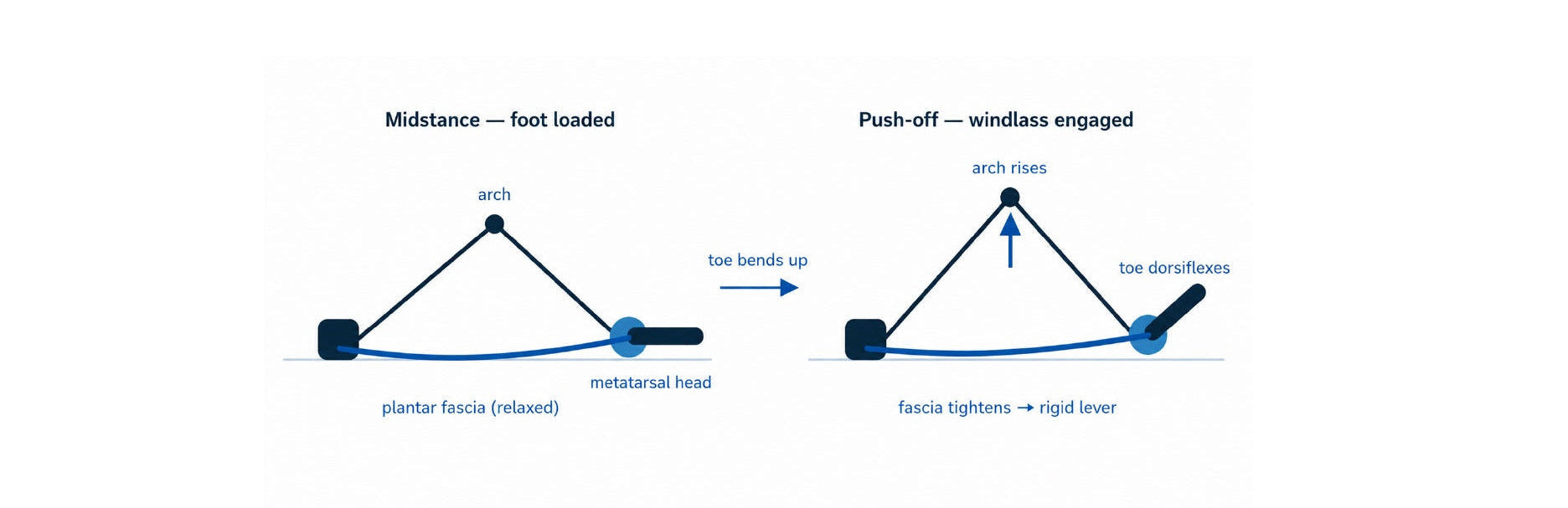
As the heel lifts from the ground, the toes are 'forced' to dorsiflex, tightening the plantar fascia (the windlass mechanism). The arch rises and the foot supinates into a firm, stable base, enabling the legs to propel the body forward.
WHAT GOES WRONG
Excessive strain through push-off can overload the tissues and lead to injury.
HOW INTERPOD ASSISTS IT
The key to assisting supination is assisting the windlass. All four design features help the first ray drop so the first toe (and toes 2–5) can bend with less force. - Rearfoot wedge — stops pronation lifting the first ray. - Cuboid notch — steadies the outer midfoot so the tendon can pull the first ray down. - 1st ray cutaway — clears the shell so the first ray is not blocked. - Plantar fascial groove — lowers the force needed to wind the fascia once the ray is free. This tightens the plantar fascia, initiating the windlass — a naturally occurring system that reduces the strain placed on the muscles, tendons and ligaments of the foot and legs.
THE PROOF
La Trobe tested the Plantar Fascial Groove on Interpod: force to establish the windlass was lower at every angle (p<0.001). The wedge, notch and cutaway assist the same mechanism; only the groove has that Interpod result.
The Windlass Mechanism
How the foot raises its own arch at push-off — the system all four design features assist, by freeing the first ray and lowering the force to bend the big toe.
Established biomechanics — applied in our own research
The windlass is foundational foot science. Interpod's design features are built to work with it — and our own independent research has tested that they do.
THE ESTABLISHED SCIENCE
INTERPOD'S OWN RESEARCH
How it all connects
Four design features working together throughout every step to achieve one outcome: reduced tissue stress and reduced symptoms.
NeuroFlex™ — support and comfort, engineered together
The hardest problem in orthotic design is giving a foot real support while keeping it comfortable enough to wear all day — the two usually pull against each other. NeuroFlex is the material we've developed and refined over 27 years to do both.
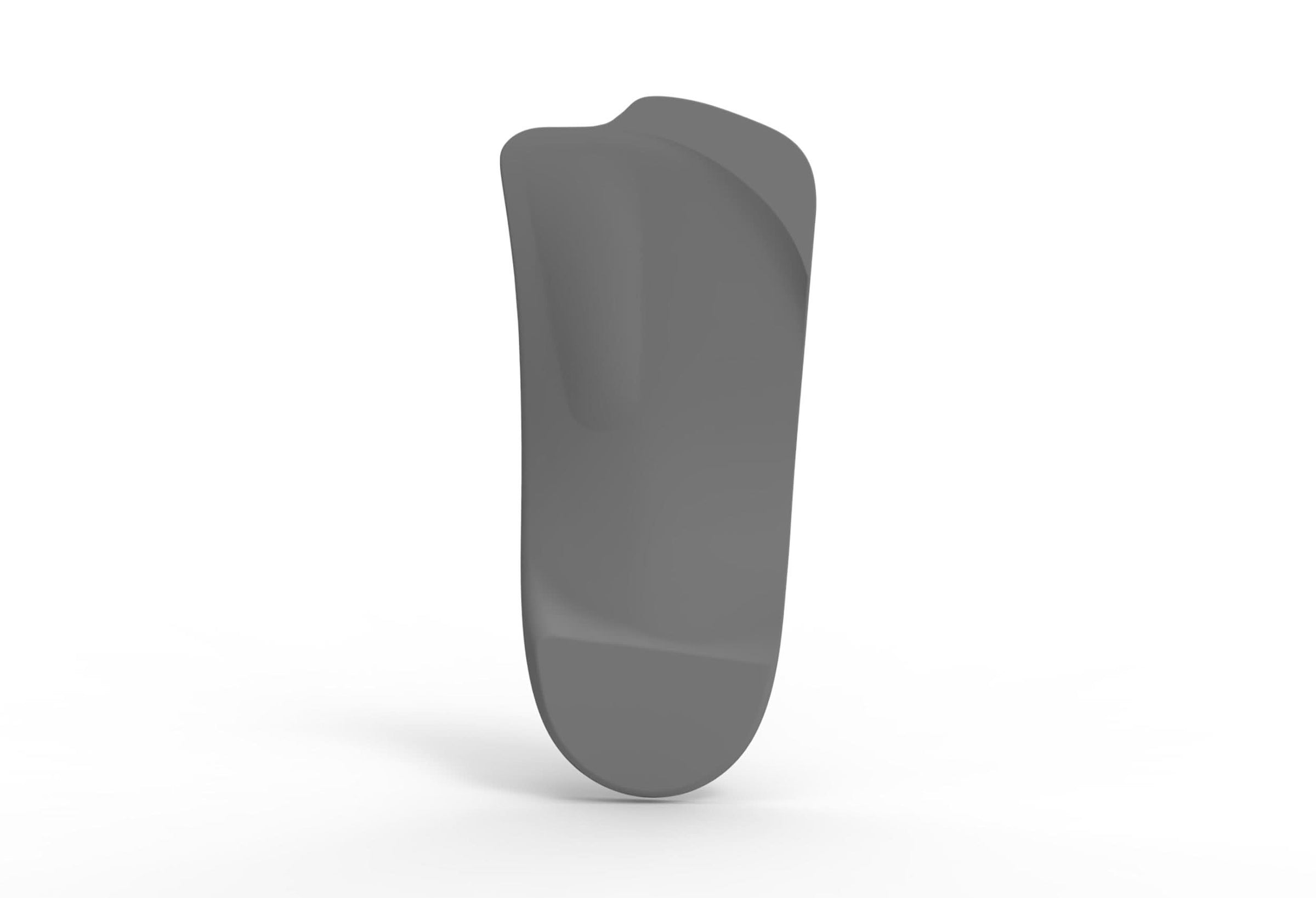
Support that springs, instead of squashing
Most insoles are thick and soft. They sit on the floor of the shoe and compress under your weight, so the support you get depends on the shape of the shoe.
NeuroFlex works differently. The arch never rests on the shoe floor — the orthotic contacts only at the heel and the ball of the foot, with the arch bridging between them just above the sole. That bridge acts as a spring. Under body weight it flexes and recoils rather than flattening out — enough give for comfort, without collapsing and losing support.
We’ve refined that preferred amount of flex over 27 years of clinical use and built it into the Model P and Interpod 3D range.
✓ Shank-independent — consistent support across shoes
✓ Springs under load — comfort without losing support
✓ Thin, light and flexible— fits into far more footwear
✓ Holds its properties for years — EVA compresses and fades
✓ 5 year warranty — built to last
This is what separates medical-grade from generic
Most insoles offer arch support and cushioning. Interpod engineered four biomechanical design features — the same features found in custom orthotics costing $500–$1,000. No retail insole has them.
| Design Feature | Retail Insoles Superfeet · Formthotics · Vionic · Footlogics · Power Steps | Custom Orthotics | Interpod |
|---|---|---|---|
| Arch support | ✓ Basic | ✓ | ✓ |
| Rearfoot Wedge | × | ✓ | ✓ |
| Cuboid Notch | × | ✓ | ✓ |
| 1st Cutaway | × | ✓ | ✓ |
| Plantar Fascial Groove | × | ✓ | ✓ |
| Replaceable Top Covers | × | ✓ | ✓ |
| University research | × | Varies | ✓ 8 studies |
| Price | $15–$40 | $500–$1,000+ | $65–$85 |