

The prefabricated orthotic with custom orthotic features
Interpod is the only prefabricated foot orthotic with 8 independent university studies, four biomechanical design features found in custom orthotics, and the Keystone — an objective supination resistance device that takes the guesswork out of orthotic prescription.
ARTICLES
DIFFERENCE IN
COMFORT OR FIT
EFFICIENCY
WORLDWIDE
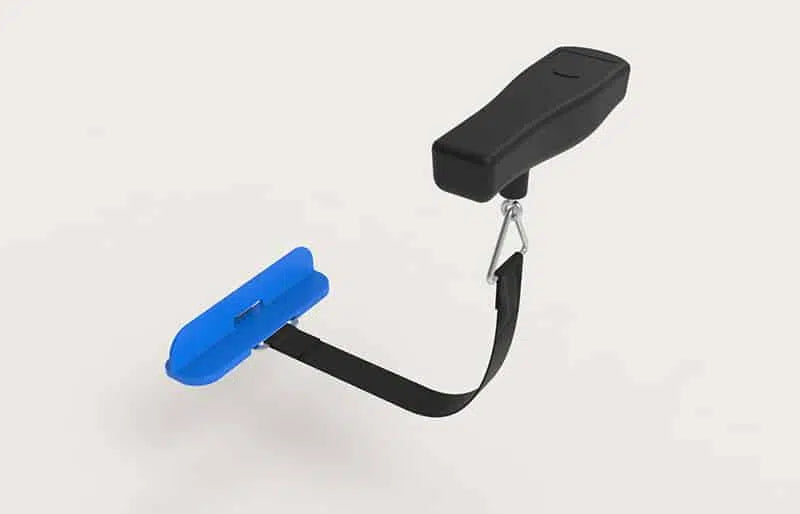
The Keystone — supination resistance measurement
The Keystone is a handheld clinical device that objectively measures the force required to supinate the foot. It replaces subjective assessment with a quantifiable measurement, enabling consistent and repeatable orthotic prescription.
How it works: The practitioner applies supination force to the patient's foot while standing. The Keystone measures the resistance in Newtons. This value directly correlates with the pronation forces the orthotic must resist — and determines whether the patient needs Low, Moderate, or High arch support.
-
Measure
Position the Keystone under the navicular and apply supination force. Record the reading in Newtons.
-
Prescribe
Low supination resistance → Low arch. Moderate → Moderate arch. High → High arch. The measurement determines the minimum effective level of support.
-
Dispense
select the appropriate Interpod product and arch height. No casting, scanning, or lab turnaround required.


🎓 Reliability validated — Université du Québec & Charles Sturt University
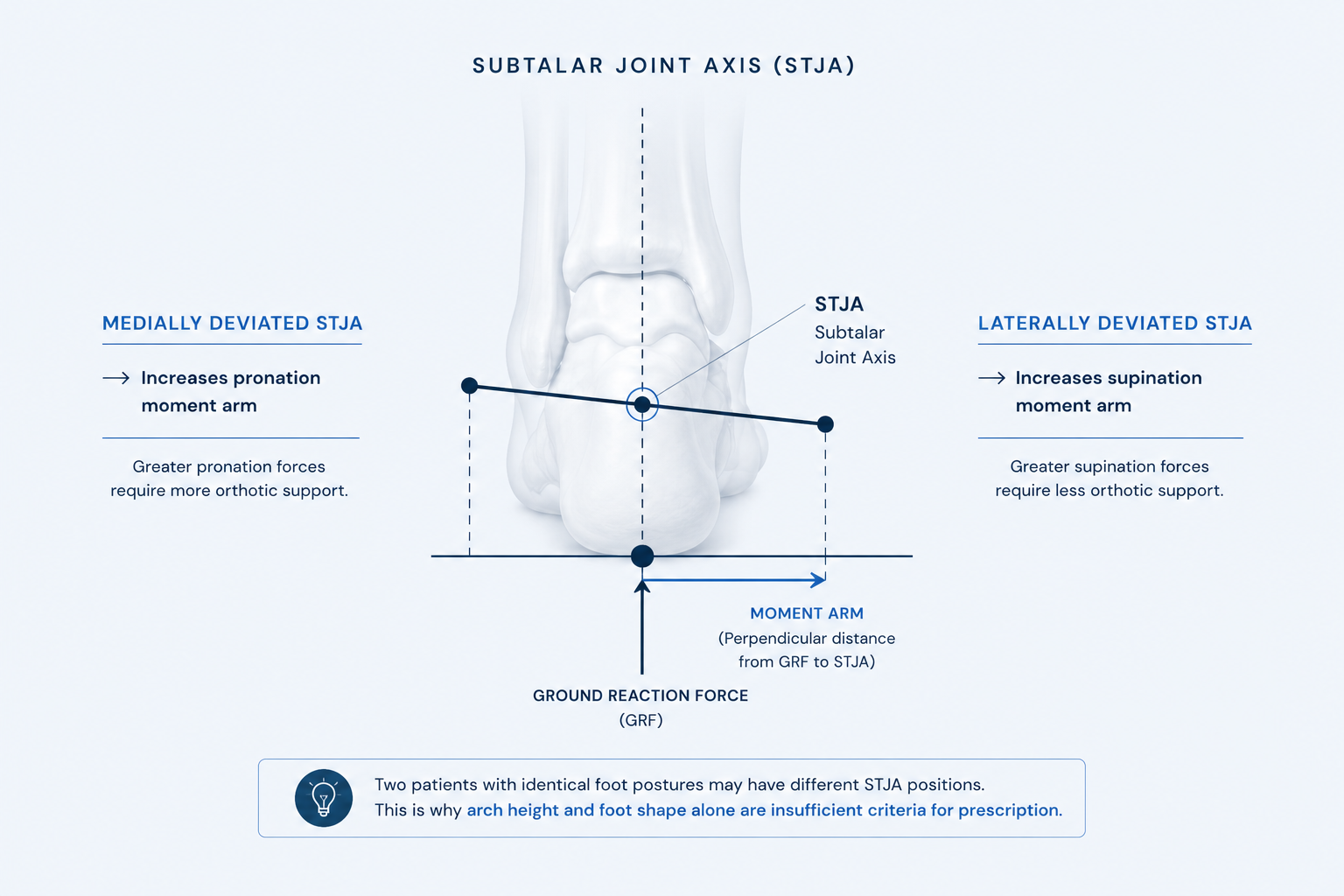
Subtalar joint axis theory — why axis position matters
The position of the subtalar joint axis (STJA) in the transverse plane determines the magnitude of pronation and supination moments generated by ground reaction forces during gait. This is the fundamental biomechanical principle that underpins Interpod orthotic prescription.
A medially deviated STJA increases the moment arm for ground reaction forces on the lateral side of the axis, generating greater pronation moments. These feet require more orthotic support to resist pronation.
A laterally deviated STJA decreases the pronation moment arm and increases the supination moment arm. These feet generate less pronation force and require less orthotic support.
This explains why two patients with identical foot postures may require different levels of orthotic support — and why arch height and foot shape alone are insufficient criteria for prescription. The Keystone measures the functional consequence of axis position (supination resistance), providing a clinically practical proxy for this biomechanical variable.
-
Low Supination Resistance
Laterally positioned axis. Lower pronation forces. Prescribe Low arch support. These patients typically do well with the Flex 4° or Soft Low arch.
-
Moderate Supination Resistance
Normal axis position. Moderate pronation forces. Prescribe Moderate arch support. Flex 6° or Soft Moderate arch is typically appropriate.
-
High Supination Resistance
Medially deviated axis. High pronation forces. Prescribe High arch support. Flex 8° or Soft High arch provides the maximum correction. Consider if custom may still be indicated for very high readings.


How to prescribe Interpod orthotics
A five-step protocol for objective, repeatable orthotic prescription using the Keystone device and Interpod product range. Based on the Interpod Custom Library approach — a library of pre-made orthotics with known levels of support that eliminates lab errors, casting, and turnaround time.
-
Determine Orthotic Support (Keystone)
Use the Keystone Device to measure supination resistance with the patient standing in relaxed stance. This measurement determines the minimum effective level of orthotic support needed.
Low resistance (<100N) → Low arch support (4° rearfoot wedge, low material stiffness). Moderate resistance (100–200N) → Moderate arch support (6° rearfoot wedge). High resistance (200+N) → High arch support (8° rearfoot wedge, consider high material stiffness).
High stiffness NeuroFlex™ is recommended for medially deviated subtalar joint axes and heavier patients where greater resistance to pronation is required.
-
Check the Windlass Mechanism
Perform Jack's Test — dorsiflex the hallux and check 1st metatarsal and 1st ray motion. This determines whether forefoot additions are required to assist the windlass mechanism.
Design features to consider: Lateral Pads (to allow 1st met plantarflexion), Plantar Fascial Groove (reduces windlass initiation force), 1st Ray Cutaway (prevents orthotic blocking forefoot function), or increased rearfoot wedging.
-
Lunge Test
Check dorsiflexion available at the ankle joint. If dorsiflexion is limited, use Heel Lifts (4mm or 6mm)to prevent the orthotic pushing into the patient's arch and creating discomfort. Heel lifts also reduce Achilles tension and compensate for limb length differences.
-
Select Product Range
Choose the product range based on clinical indication, patient footwear, and material preference:
Flex Original (NeuroFlex™) — shank independent. ¾ shell with full cover. 4°/6°/8° rearfoot wedge. Single stiffness. Rearfoot Wedge, Cuboid Notch, Plantar Fascial Groove.
Flex New (NeuroFlex™) — shank independent. ¾ shell with full cover. 4°/6°/8° rearfoot wedge. Low & High stiffness. Improved Plantar Fascial Groove + 1st Ray Cutaway. Also available in 0° (no rearfoot wedge).
Soft (Polyurethane) — superior shock absorption. Full-length and ¾-length. Shank dependent. Available in 4°/6°/8° arch heights, or 0° with Low & High stiffness for cushioning without rearfoot wedge.
Diabetic (Polyurethane + PORON 96) — pressure redistribution for the at-risk foot. Proven 20% more efficient at reducing forefoot pressure-time integral vs custom total contact insoles (NHS Plymouth).
Modular (EVA) — interchangeable arch inserts. Ideal when the practitioner wants the patient to trial multiple levels before committing, or for dispensing at point of care.
-
Fit to Foot and Shoe
Select device size using the Interpod size chart. Fit the device in the patient's shoe, check for comfort, and assess rearfoot position with the device in situ. Confirm the heel sits centred in the heel cup and the arch contour matches the foot without excessive pressure. Sometimes the patient must be advised to wear a more supportive shoe to accommodate the orthotic — if the patient is unwilling to compromise, a slimmer device may be needed.
No lab turnaround. No casting. No scanning. Dispense same-day from your on-site stock.


-
Short & Medium Term Use
Orthotics are effective in the short term because alternative treatment options — such as increasing tissue capacity through mechanobiology techniques like eccentric loading, or changing running form — take time. Orthotics bridge the gap by reducing tissue strain while these adaptations occur.
-
Long Term Use
Long-term orthotic use may be necessary where the patient will not comply with exercises, where repetitive loads are too high for tissue adaptation, or where an individual's biomechanics produce high joint moments due to subtalar joint axis position. Excessive body weight can also be a contributing factor.
Complete practitioner range
A library of pre-made orthotics with known levels of support. Every product features the Rearfoot Wedge, Cuboid Notch, 1st Ray Cutaway, and Plantar Fascial Groove — the same design features found in custom orthotics.
-
Clinical

Flex Range (Original)
NeuroFlex™ — Shank Independent
The original clinical Flex device. ¾ shell with full cover. Available in 4°, 6°, and 8° rearfoot wedge. Single stiffness. Integral rearfoot posting over the subtalar joint axis eliminates pronation moments created by lateral heel cups.
4° / 6° / 8° Rearfoot Wedge Cuboid Notch Plantar Fascial Groove ¾ Shell + Full Cover Optional full length EVA self-adhesive cover -

Flex Range (New)
NeuroFlex™ — Shank Independent — Low & High Stiffness
The updated Flex with improved Plantar Fascial Groove and the addition of 1st Ray Cutaway. ¾ shell with full cover. Available in 4°, 6°, and 8° rearfoot wedge. Low and High stiffness — use High stiffness for medially deviated subtalar joint axes and heavier patients where greater resistance to pronation is required.
4° / 6° / 8° Rearfoot Wedge Low & High Stiffness Cuboid Notch Improved Plantar Fascial Groove 1st Ray Cutaway ¾ Shell + Full Cover Optional full length EVA self-adhesive cover -

Flex 0 Degree
NeuroFlex™ — Shank Independent — Low & High Stiffness
Arch support with heel cup but no rearfoot wedging. For patients who need arch contouring and biomechanical design features but where rearfoot posting is not indicated. Low and High stiffness options.
0° (No Rearfoot Wedge) Heel Cup Cuboid Notch Improved Plantar Fascial Groove 1st Ray Cutaway Low & High Stiffness Optional full length EVA self-adhesive cover -

Soft Range (4°/6°/8°)
Polyurethane — Full Length & ¾ Length — Shank Dependent
Superior shock absorption with biomechanical support. Polyurethane base resists compression for consistent, long-lasting support. Available in three arch heights with rearfoot wedging.
4° / 6° / 8° Rearfoot Wedge Full / ¾ Length Cuboid Notch Plantar Fascial Groove -

Soft Range (0°)
Polyurethane — Full Length — Low & High Stiffness — Shank Dependent
Full-length cushioning with arch contouring but no rearfoot wedging. Available in Low and High stiffness. Use when shock absorption and comfort are the primary goals without rearfoot correction.
0° (No Rearfoot Wedge) Full Length Low & High Stiffness -

Diabetic 6°
Polyurethane + PORON 96 Top Cover — Full Length
For the at-risk diabetic foot requiring biomechanical support. 6° rearfoot wedge provides moderate pronation control alongside PORON 96 pressure redistribution. NHS Plymouth research showed 20% greater efficiency at reducing forefoot pressure-time integral vs custom total contact insoles.
6° Rearfoot Wedge PORON 96 Full Length Soft Pressure Redistribution -

Diabetic 0°
Polyurethane + PORON 96 Top Cover — Full Length — Low & High Stiffness
For the at-risk diabetic foot where pressure redistribution and cushioning are the primary goals without rearfoot wedging. 0° neutral platform with PORON 96 top cover. Available in Low and High stiffness to match patient weight and tissue vulnerability.
0° (Neutral) PORON 96 Full Length Soft Low & High Stiffness -

Modular (EVA)
EVA Base + 3 Interchangeable Arch Inserts
The Modular system in a clinical setting. Dispense the EVA base with all three arch inserts. Patient trials each level progressively. Ideal for point-of-care dispensing or when the Keystone is unavailable.
3 Arch Inserts Rearfoot Wedge Same-Day Dispense Patient Self-Trial -

Kids Range
Age-appropriate biomechanical support
Paediatric sizing with the same design features as the adult range. For developmental flat foot, Sever's disease, and growing-related lower limb pain. Available in Soft and Flex materials.
Paediatric Sizes 3 Arch Heights Rearfoot Wedge Soft & Flex -

Keystone Device - Clinical Tool
Digital Supination Resistance Measuring Device
Handheld clinical device that objectively measures the force required to supinate the foot in Newtons. Determines the minimum effective level of orthotic support. Validated by Université du Québec and Charles Sturt University.
Objective Measurement Newtons Reliability Validated Orderable -

Flex Cover — Full Length
Replacement Black Suede Top Cover
Full-length replacement top covers for all Flex range devices (except 0 Degree). Extends device life without replacing the shell.
Full Length Black Suede All Flex (excl. 0°) XS–XXL


Forefoot Additions & Heel Lifts
-
PMP Pad
Redistributes pressure from the metatarsal heads. Can be trimmed to form a Met Bar for Morton's Neuroma. Also used to create a Reverse Windlass effect for patients with clawed toes.
-
Lateral Pad
Elevates metatarsals 2–5, allowing the 1st metatarsal to plantarflex — increasing dorsiflexion for improved Windlass function.
-
Heel Lifts (4mm & 6mm)
For decreased ankle dorsiflexion (as determined by the Lunge Test), Achilles tension, or limb length differences. Can also be trimmed and orientated on the orthotic heel to increase rearfoot wedging.
Size Chart
| Size | UK | Euro | US/Aus |
|---|---|---|---|
| XS | 2.5–3.5 | 35–36 | 3–4 |
| S | 3–4 | 37–38 | 4–5 |
| M | 5–6 | 39–40 | 6–7 |
| L | 7–8 | 41–42 | 8–9 |
| XL | 9–10 | 43–44 | 10–11 |
| XXL | 11–12 | 45–46 | 12–13 |
| XXXL | 13+ | 46+ | 14+ |
| Size | UK | Euro | US/Aus |
|---|---|---|---|
| XS | 2.5–3.5 | 35–36 | 4–5 |
| S | 3–4 | 37–38 | 5–6 |
| M | 5–6 | 39–40 | 7–8 |
| L | 7–8 | 41–42 | 9–10 |
| XL | 9–10 | 43–44 | 11–12 |
| XXL | 11–12 | 45–46 | 13–14 |
| XXXL | 13+ | 46+ | 15+ |
| Size | UK | Euro | US/Aus |
|---|---|---|---|
| K-S | 10.5–12 | 29–30.5 | 11–12.5 |
| K-M | 12.5–1 | 31–32 | 13–2 |
| K-L | 1.5–2.5 | 33–34 | 2–3 |
Four features — same as custom orthotics
Every Interpod device includes four biomechanical design features typically only found in custom-made orthoses. These features work together across both phases of gait.
-
Rearfoot Wedge
Integral rearfoot inversion blended into midfoot arch support. Resists pronation and assists supination. Available in 4°, 6°, and 8° across the range. La Trobe University confirmed Interpod is the most effective prefabricated orthotic at controlling rearfoot position.
-
Cuboid Notch
Assists supination during midstance to push-off transition by supporting the lateral column. Typically only found in custom orthoses. Enhances the foot's natural resupination mechanism.
-
1st Ray Cutaway
Allows natural first ray plantarflexion during push-off. Prevents the orthotic from blocking forefoot function — a common limitation of rigid prefabricated devices. Critical for hallux valgus and forefoot.
-
Plantar Fascial Groove
Reduces the force required to establish the windlass mechanism (p <0.001 at all angles — La Trobe). Improves gait efficiency and reduces arch irritation. Unique to Interpod.
4 international universities, 13 evidence based articles
The most extensively researched prefabricated foot orthotic in the world. All studies are independent and unpaid — conducted by university researchers using standard academic protocols.
-
La Trobe University
No difference in comfort and fit vs custom-made orthoses
-
La Trobe University
Plantar fascial groove reduces windlass force (p <0.001)
-
La Trobe University
All arch heights produce significant changes (p <0.0001)
-
Duquesne University (USA)
Significant reduction in internal tibial rotation
-
NHS / Fleck’s NHS Note
+28% gait efficiency (PURITY Index)
-
Université du Québec & Charles Sturt
Keystone reliability validated
-
La Trobe University
Supination resistance and rearfoot wedging correlation
-
La Trobe University
Craig Payne — 20 years of research leadership
-
Multiple Institutions
5 universities, 4 countries
Interpod vs Custom Orthotics
La Trobe University found no difference in comfort or fit between Interpod and custom-made devices. Interpod includes all four biomechanical features found in custom orthotics.
| Generic Prefab | Custom Orthotic | Interpod | |
|---|---|---|---|
| Rearfoot Wedge | × | ✓ | ✓4°/6°/8° |
| Cuboid Notch | × | ✓ | ✓ |
| 1st Ray Cutaway | × | ✓ | ✓ |
| Plantar Fascial Groove | × | Varies | ✓p<0.001 |
| 3 Arch Heights | × | N/A (moulded) | ✓ |
| Objective Prescription | × | Cast/Scan | ✓Keystone |
| Same-Day Dispense | ✓ | ×2–4 weeks | ✓ |
| University Research | × | Varies | ✓8 studies |
| Comfort = Custom | × | — | ✓La Trobe |
| Patient Cost | $15–$40 | $500–$1,000+ | $65–$135 |
Two ways to partner with Interpod
Interpod serves practitioners and distributors through two separate routes. Choose the one that fits.
For PRACTITIONERS
Open a clinical account
Wholesale pricing, bulk ordering, the Keystone device, clinical resources, and dedicated practitioner support. For registered podiatrists, physiotherapists, chiropractors, and allied health professionals.
orders@interpod.com.au
FOR DISTRIBUTORS
Become a distribution partner
Territory distribution rights, wholesale margin, training on the Keystone method, and the full Interpod research and marketing portfolio. Medical distributors, pharmacy partners, and sports channels.
orders@interpod.com.au